
School Health
School Health
Continuing Education (CE) Courses
Continuing Education (CE) Courses
California-focused, self-paced CE courses for school nurses and school health professionals.
California-focused, self-paced CE courses for school nurses and school health professionals.
Complete all required CE hours in one place
Complete all required CE hours in one place
Our Courses
Required School Health Compliance Courses
Commonly required for annual compliance
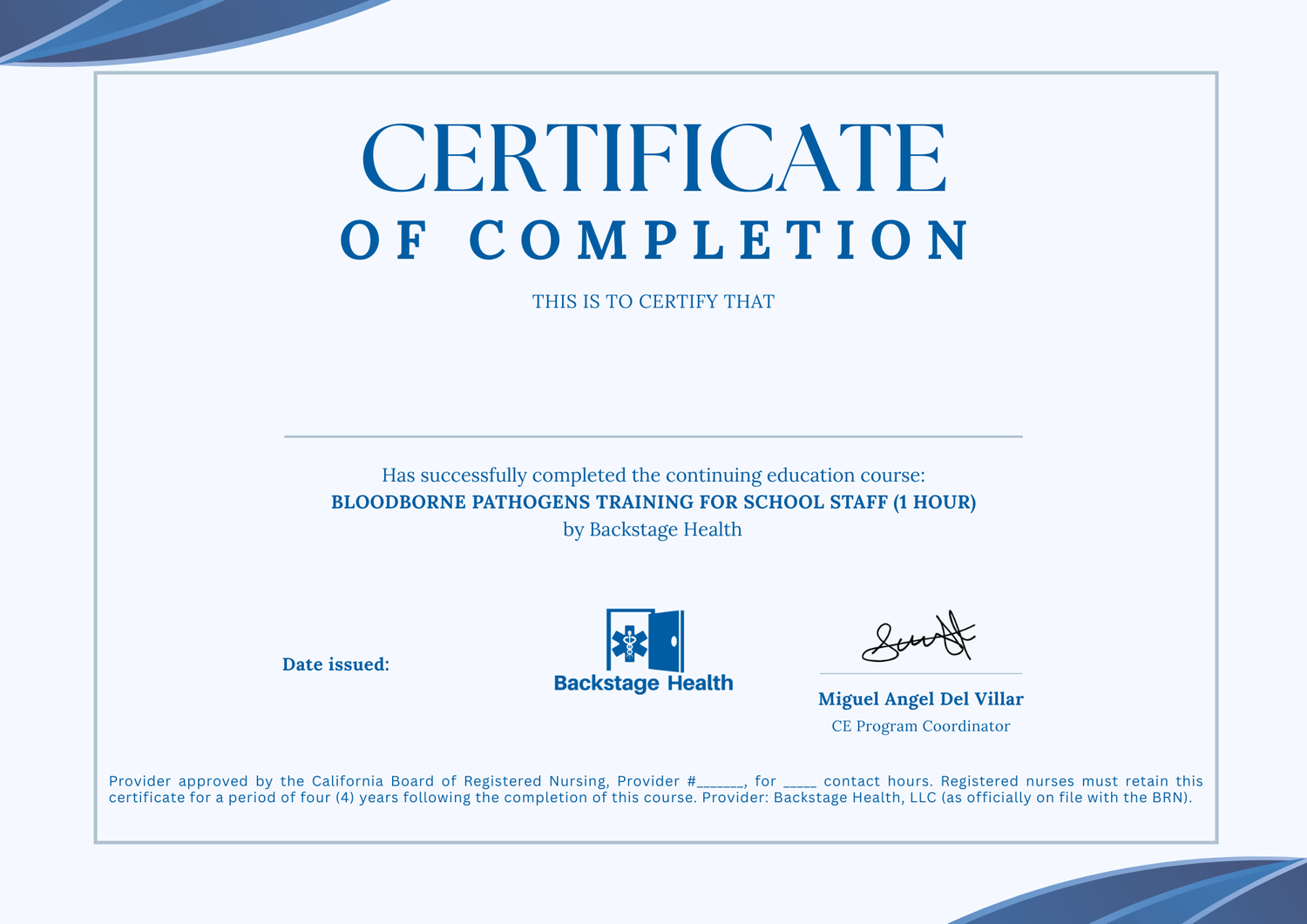
Bloodborne Pathogens & Universal Precautions
1.0 BRN CE Hour
Essential training on preventing exposure and responding safely in school settings.
Define bloodborne pathogens and how they spread
Recognize common school exposure situations
Apply universal precautions and PPE correctly
Follow post-exposure protocols with confidence
Understand OSHA & Cal/OSHA standards
Mandated Reporting for School Professionals
2.0 BRN CE Hours
Understand your legal duty to recognize and report suspected abuse or neglect.
Explain your responsibilities as a mandated reporter under California law.
Recognize indicators of child abuse and neglect.
Respond appropriately if a child discloses abuse.
File a report correctly and on time.
Understand what happens after a report is filed.
Legal & Ethical School Nursing
2.5 BRN CE Hours
Navigate legal responsibilities and ethical decision-making with confidence.
Distinguish between FERPA and HIPAA in school health settings.
Explain California’s minor consent laws and how they affect school nursing.
Apply principles of confidentiality and ethical decision-making to real-world scenarios.
Identify best practices for documentation in the school health office.
Analyze case studies to recognize legal and ethical dilemmas and apply correct responses.
Sexual Harassment Prevention Training (Nonsupervisory Employees)
1.5 BRN CE Hours
Promote a respectful and compliant school workplace.
Define sexual harassment under California and federal law in the school workplace.
Distinguish between quid pro quo harassment and hostile work environment in school-based contexts.
Identify behaviors in school settings that may constitute harassment (staff-to-staff, staff-to-parent, staff-to-vendor).
Understand your responsibilities for reporting harassment within district policies and state law.
Recognize protections against retaliation and how they apply to school employees.
Chronic Conditions & Student Care
Daily clinical care in school settings
Managing Chronic Conditions in Schools
2.0 BRN CE Hours
Support students with common medical conditions through safe, effective care planning.
Describe common chronic conditions in schools and their risks.
Explain the role of Individualized Health Plans (IHPs).
Identify key steps in emergency response, including disaster planning.
Demonstrate safe medication management under California law.
Collaborate effectively with families, providers, and school teams.
Apply proper documentation and monitoring practices as part of school nurse oversight
Immunization Compliance & Public Health
2.0 BRN CE Hours
Ensure accurate immunization records and public health compliance.
Define California’s vaccination requirements for school entry and grade progression.
Identify unusual immunization scenarios (international records, transfers, foster/homeless students).
Explain the medical exemption process and unique considerations.
Apply best practices for educating and engaging families about vaccines.
Manage immunization records (CAIR, Shots for School) effectively and report to CDPH/local health departments.
Adolescent Sexual & Reproductive Health
1.5 BRN CE Hours
Support adolescent health with accurate, confidential care.
Identify adolescent risk factors for substance use
Recognize the most common substances affecting youth
Explain California’s minor consent law and its implications in schools
Apply SBIRT strategies in a school setting
Support prevention, education, and referral efforts
Collaborate with families, colleagues, and community resources
Screenings, Prevention & Public Health
Early identification and follow-up
Vision, Hearing & Health Screenings
2.0 BRN CE Hours
Learn how to conduct screenings accurately and manage follow-up care.
Identify the California laws that mandate health screenings in schools.
Describe best practices for oral, vision, hearing, and scoliosis screenings.
Explain the provider qualifications for each type of screening.
Outline the process for reporting, referral, and follow-up.
Apply resources and case examples to strengthen screening programs.
COVID-19, RSV, Influenza & Emerging Infectious Diseases
1.5 BRN CE Hours
Stay current on infectious disease prevention and response in schools.
Describe the role of the school nurse in infectious disease prevention and outbreak response.
Apply CDPH and California Education Code requirements for exclusion, testing, and reporting.
Identify signs and symptoms of COVID-19, RSV, influenza, and emerging infectious diseases in school-aged children.
Develop strategies to reduce transmission through vaccination promotion, communication, and prevention campaigns.
Substance Use Awareness & Prevention in Schools
2.0 BRN CE Hours
Support prevention and early intervention for substance use concerns.
Identify adolescent risk factors for substance use
Recognize the most common substances affecting youth
Explain California’s minor consent law and its implications in schools
Apply SBIRT strategies in a school setting
Support prevention, education, and referral efforts
Collaborate with families, colleagues, and community resources
Emergency Response, Crisis & Safety
Preparedness for medical and behavioral emergencies
Emergency Preparedness & School Safety
1.5 BRN CE Hours
Prepare for medical and behavioral emergencies with clear response plans.
Differentiate between medical emergencies and school-wide disasters.
Describe California-specific laws for AEDs, epinephrine, and naloxone.
Apply step-by-step response procedures for common medical crises.
Explain the planning process for disaster and school-wide emergencies.
Identify the role of the school nurse within the Incident Command System.

Recognizing & Responding to Child Crisis
2.5 BRN CE Hours
Identify warning signs and respond effectively to student crises.
Recognize signs of student mental health crises (anxiety, depression, self-harm, suicidal ideation).
Follow suicide risk and harm-to-others protocols in California schools.
Apply PBIS/MTSS strategies to de-escalate crises.
Collaborate with families, providers, and crisis response teams.
Document and report in compliance with California law (AB 2246, AB 1767, AB 1432).
Trauma-Informed School Health Practices
1.0 BRN CE Hours
Support students affected by trauma with safe, compassionate care.
Define trauma-informed care and its core principles.
Describe the impact of Adverse Childhood Experiences (ACEs) on health, learning, and behavior.
Recognize common signs of trauma in the school health office setting.
Apply trauma-sensitive communication strategies when responding to students.
Advocate for integrating trauma-informed practices into school health and district frameworks.
School Nursing Practice & Leadership
Professional role clarity and daily operations
Managing the School Health Office
1.5 BRN CE Hours
Streamline daily operations for a more efficient health office.
Organize and maintain a functional school health office
Manage essential emergency supplies and medications
Implement effective workflows and triage systems
Delegate appropriately to unlicensed staff while ensuring oversight
Train and support school staff in basic health and emergency tasks
Use a school nurse calendar to stay on top of California compliance requirements
School Nurse’s Role in IEP & 504 Plans
1.5 BRN CE Hours
Clarify your role in supporting students with specialized health needs.
Differentiate between IDEA and Section 504 in the school setting
Explain the school nurse’s unique role in the IEP and 504 processes
Identify how health conditions impact a student’s ability to access learning
Recommend accommodations and supports that align with legal frameworks
Advocate for student health needs within interdisciplinary teams
Foundations of School Nursing Practice in California
2.5 BRN CE Hours
Understand California-specific requirements for school nursing practice.
Describe the role and responsibilities of California school nurses.
Differentiate RN scope of practice from that of unlicensed staff.
Identify credentialing requirements for California School Nurses (CSN).
Apply a standardized framework to guide practice in any health-related school topic.
Recognize the legal foundations that govern school health services
Behavioral Health & School Systems
Whole-child and systems-based approaches
PBIS in Practice
1.5 BRN CE Hours
Use positive, proactive strategies to support student behavior and school climate.
Define PBIS and explain why it is important in California schools
Describe the tiered system of supports (Tiers 1–3)
Identify real-world scenarios where PBIS strategies apply
Apply positive behavior strategies in your daily role, including in the health office
Recognize the compliance requirements of AB 1172

Cultural Competence & Equity in School Nursing
1.5 BRN CE Hours
Provide inclusive, culturally responsive care for all students.
Define cultural competence, equity, and health disparities.
Describe the school nurse’s role in promoting equity.
Identify inequities that impact student health and learning.
Apply culturally responsive strategies in the school health office.
Incorporate California-specific frameworks into practice.
Trusted by school nurses, districts, and school health professionals across California.

The Annual CE Pass — Best Value for School Professionals
Earn 30+ BRN-Approved Contact Hours
Get unlimited access to all CE courses for one year. Save money and learn at your pace — ideal for school nurses and health teams.
12 months of self-paced learning
Contact hours across all courses
Learn anytime, on any device
Full access immediately
Cheaper than buying individual courses
Most popular option for California school nurses - Certificates included - Instant access
FAQ
Frequently asked questions
Answers to common questions from school nurses and school professionals.
Yes. All courses are approved for California BRN continuing education.
Certificates are issued immediately after successful course completion.
Yes. All courses are self-paced and available online.
No. Courses may be purchased individually or accessed through the Annual Health Access Pass.